
What our Whole-Life Leadership conversation honoring Clayton Christensen made clearer for me
TL;DR
- Most people do not lose what matters through one dramatic mistake. They lose it through quiet drift.
- We tend to optimize for what feels urgent, measurable, and immediately rewarding.
- The long-term quality of our lives is shaped by relationships, integrity, and repeated choices.
- Whole-life leadership requires more than good intentions. It requires humility, accountability, and regular course correction.
- TL;DR
- 1. Your life strategy is not what you say—it’s what you do repeatedly
- 2. The drift happens quietly—through signals we choose to ignore
- 3. You don’t need more willpower—you need better systems and honest mirrors
- What measuring your life really requires
- A few reflection questions
Most of us already know what matters most.
That is not the problem.
The problem is that on a random Tuesday, the urgent thing usually feels louder than the important one. The email is clearer than the marriage. The deadline is easier to measure than the child. The quick win gives faster feedback than character ever does.
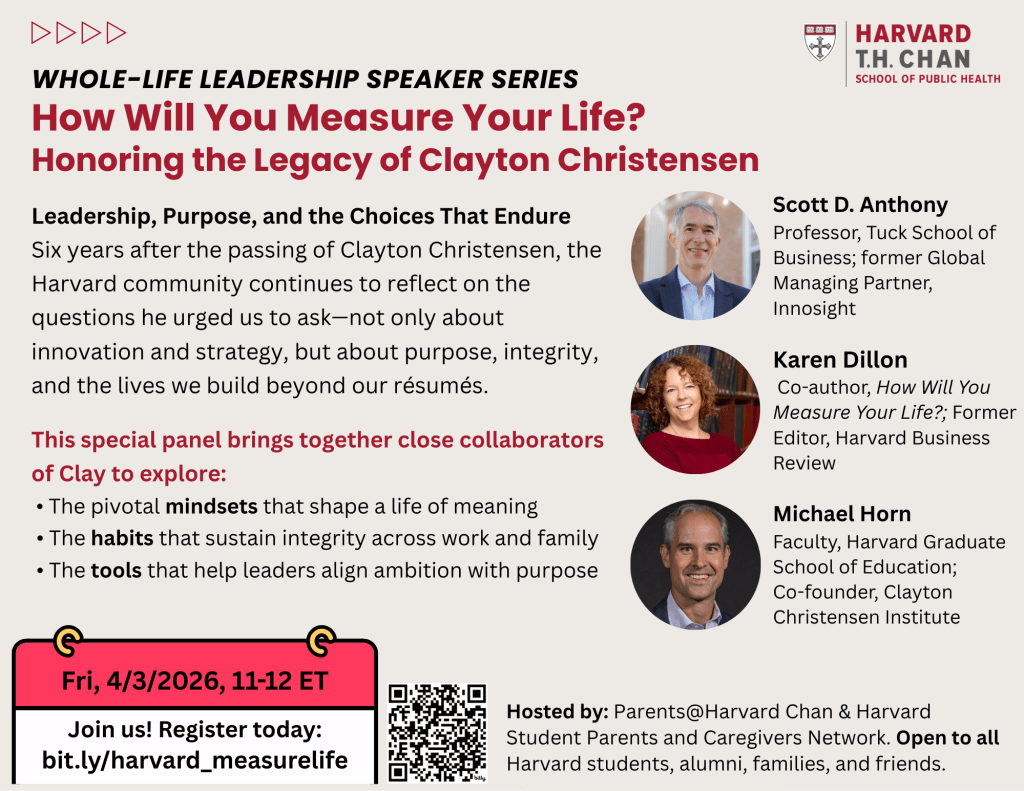
That was one of the strongest themes from our recent Whole-Life Leadership conversation honoring Clayton Christensen’s legacy.
Six years after Clay’s passing, his most enduring question still cuts deeper than strategy or innovation:
How will you measure your life?
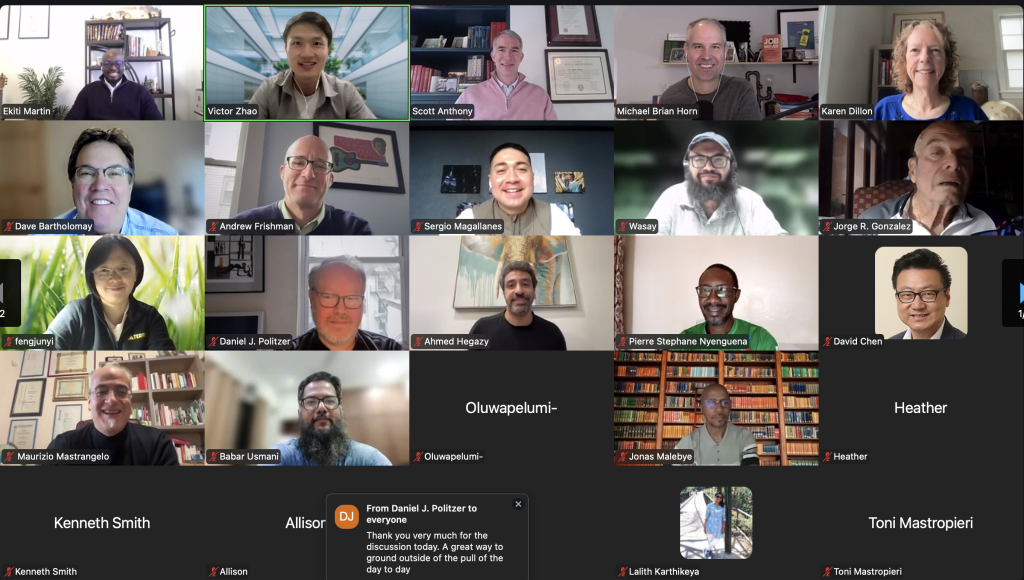
Through the Parents@Harvard Chan community, I recently co-moderated a Whole-Life Leadership conversation with Scott Anthony, Karen Dillon, and Michael Horn—three thinkers deeply shaped by Clay’s work.
What emerged wasn’t a neat set of answers. It was a clearer understanding of how easily a well-intentioned life can drift—and what it actually takes to stay aligned over time.
My top 3 takeaways:
1. Your life strategy is not what you say—it’s what you do repeatedly
Karen Dillon shared a moment that changed the trajectory of her own life: a conversation with Clay that began as an article interview and ended as a personal reckoning.
At the heart of it was a simple but uncomfortable realization:
We often believe we’re prioritizing what matters most. But our calendars—and our habits—tell a different story.
Clay’s theory of strategy applies just as powerfully to individuals as it does to companies:
Strategy is formed through how resources are actually allocated.
We may say family matters most. We may say faith matters, health matters, integrity matters. But our calendars and habits often reveal a different operating system.
- A few extra hours at work.
- A postponed conversation.
- A family moment that “can wait.”
- A spiritual habit squeezed out by fatigue.
- A body kept going on caffeine and momentum.
Individually, these feel small. Over time, they become a life.
We naturally drift toward what feels most urgent and what gives the fastest feedback loop. Work often does both. Relationships usually do not.
The long-running Harvard Study of Adult Development (see TED Talk: What Makes a Good Life? Lessons from the Longest Study on Happiness) has repeatedly pointed to the crucial role of close relationships in long-term well-being. And yet relationships are often the first thing to get “underfunded” when life gets busy.
Whole-Life Leadership insight:
Alignment is not a goal we set once. It is a pattern of daily allocation.
2. The drift happens quietly—through signals we choose to ignore
Scott Anthony extended Clay’s theory of disruption into a deeply personal insight.
In business, organizations rarely fail because of one giant mistake. They fail because they ignore weak signals. Small signs. Subtle shifts. Things that feel easy to dismiss.
The same is true in life.
- A marriage that feels slightly flatter.
- A child who seems a little more distant.
- A quiet sense that you are becoming reactive, numb, or tired in a way that is not sustainable.
- A growing gap between what you say matters and what your life actually rewards.
These signals rarely scream. That is why they are dangerous. They are easy to rename:
- “just a busy season”
- “not a big deal”
- “I’ll deal with it later”
- “things will calm down soon”
Then one day the result feels sudden, even though the drift was happening the whole time.
That point stayed with me because drift usually does not feel dramatic. It feels reasonable. It often looks like competence under pressure. It can even look like success.
Clay often talked about integrity not as something usually lost all at once, but through small decisions that quietly move us off course.
Whole-Life Leadership insight:
Most life failures are not dramatic. They are the result of unaddressed drift.
3. You don’t need more willpower—you need better systems and honest mirrors
Michael Horn shared one of the most practical insights of the conversation: we are often poor judges of what we are actually optimizing for.
The challenge is not just discipline. It is self-awareness. And self-awareness is very difficult to build in isolation.
That is why the most effective leaders do not rely on willpower alone. They build systems—and surround themselves with people—who help them stay aligned.
That can look like:
- Clear decision rules: what is non-negotiable
- Structural habits: time boundaries, recurring rituals, protected priorities
- External perspective/accountability: spouses, mentors, and trusted feedback loops that reveal patterns we cannot see on our own
The goal is not to control life perfectly. It is to make alignment more likely—and recalibration more natural—when drift begins.
This was one of the most personal takeaways for me. We naturally drift toward what feels most urgent and what offers the fastest feedback. The challenge is not just to know that, but to let that awareness humble us. It should make us more willing to seek accountability, more open to feedback, and more ready to course-correct.
As Tim Keller wrote in The Meaning of Marriage, two of the most important skills in marriage are forgiveness and repentance. That applies to marriage, but also more broadly to a meaningful life: we need the humility to admit when we are off course—and the courage to turn back.
Whole-Life Leadership insight:
A well-designed life is not powered by discipline alone. It is shaped by systems and relationships that keep us aligned.
What measuring your life really requires
If there’s one thing this conversation reinforced for me, it’s this: the question “How will you measure your life?” is not something we answer once. We answer it quietly, repeatedly, through our allocation decisions, our relationships, our habits, and our willingness to course-correct when we drift.
In that sense, whole-life leadership is not about perfect balance or flawless execution. It is about building a life that can be recalibrated—through honesty, humility, forgiveness, repentance, and return.
Because the greatest risk is not always failure. Sometimes it is drifting, slowly and reasonably, into a life we never meant to build.
A few reflection questions
As you think about your own life:
- Where might your time allocation not reflect your true priorities?
- What small signals might you be overlooking?
- Who helps you notice when you are drifting?
- Where might repentance, forgiveness, or a simple honest conversation be needed right now?


