
By Victor Zhao, with reflections from Victoria Zhao
- 1. You Can Become a Background Character in Your Own Life
- 2. Burnout Is Not Just About Workload — It’s About the Stories Underneath It
- 3. Real Change Starts with Awareness — Then Small, Courageous Moves
- 4. Even When You Start Caring for Yourself, the Guilt Often Follows
- Up Next: Fri, 4/3: How Will You Measure Your Life? Honoring the Legacy of Clayton Christensen
Last fall, shortly after beginning my MPH in Epidemiology at Harvard T.H. Chan School of Public Health, I stepped into a co-president role with the Harvard Chan Parents Club and launched a speaker series called Whole-Life Leadership.
The goal was to explore one deceptively simple question:
What are the pivotal mindsets, habits, and tools needed to succeed—both at work and at home?
When I took on this leadership role, I talked it through with my wife Victoria first. Between work, school, and raising two young kids, life is already very full. But we both felt that the lessons from these conversations—about leadership, family, identity, and living with intention—would be valuable not only for our community, but for us as parents as well.
That has turned out to be true. After each speaker session, we usually find ourselves continuing the conversation at home.
The second installment of the speaker series, featuring Erica Chen, founder of Unicorn Dynasty and creator of the Pivot & Shimmy framework, was one of those conversations that lingered.
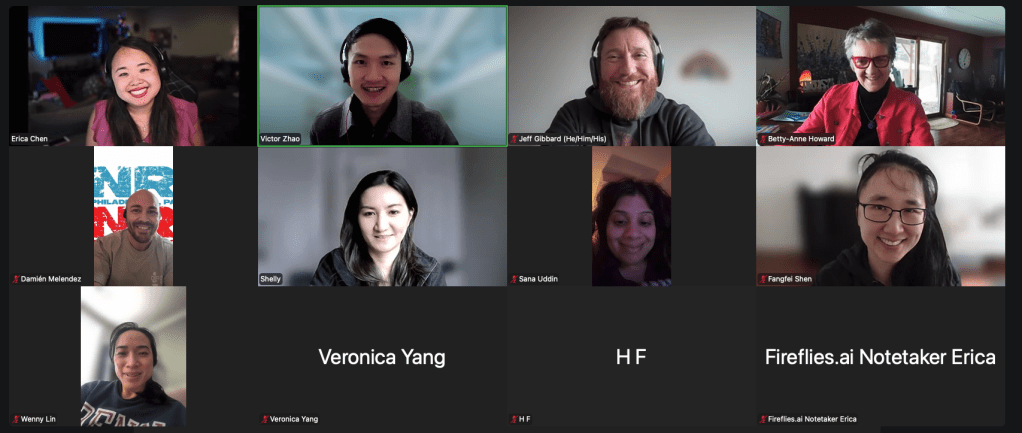
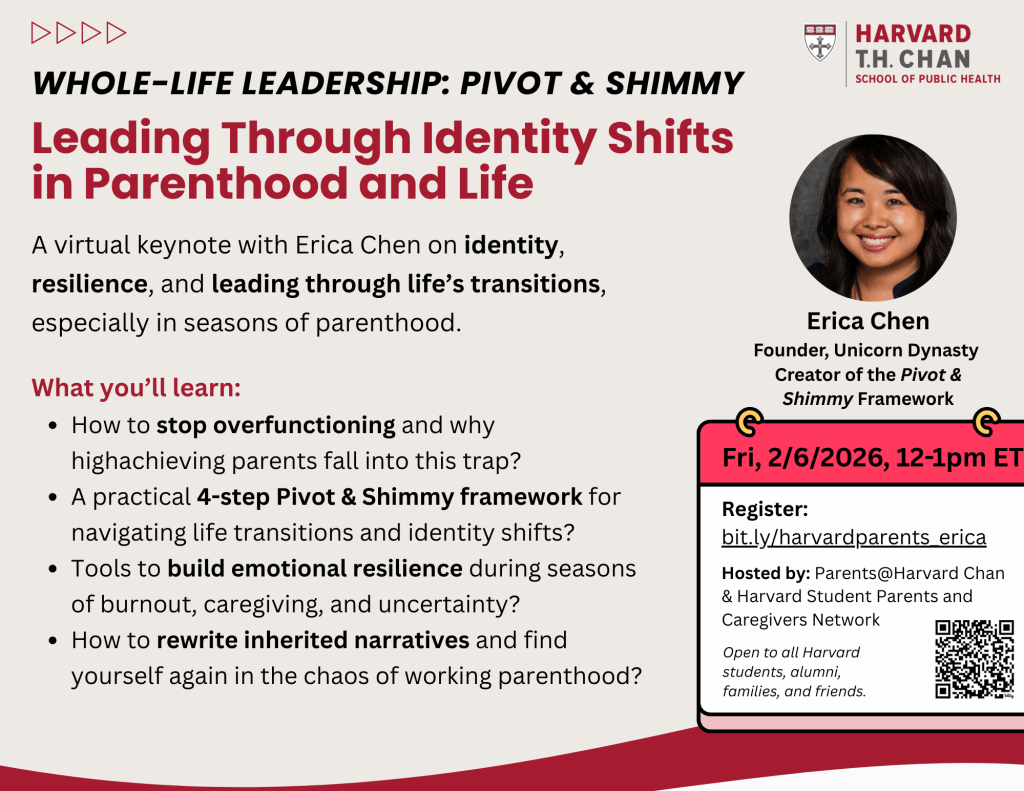
If the first event with Jim McNary focused on leadership through responsibility, service, and care for others, Erica’s keynote explored a different but equally important dimension of leadership:
What happens when the strategies that once helped you succeed no longer fit the life you’re living now?
That question felt especially relevant for parents, caregivers, and professionals navigating identity shifts in real time.
Several weeks later, three lessons from Erica’s talk still stand out to us—along with one additional reflection.
1. You Can Become a Background Character in Your Own Life
One of the most memorable moments in Erica’s talk began in a place many parents know well: behind a locked bathroom door.
She described trying to carve out two minutes of quiet, only to hear her child outside and realize something deeper than exhaustion:
somewhere along the way, she had stopped appearing in scenes for herself.
So many high-achieving people know how to keep going. We adapt. We solve. We overfunction. We become dependable at work and at home.
But sometimes the very habits that make us capable also make us disappear.
Erica described how she had learned to “pivot and shimmy” through difficulty—moving fast, recovering quickly, figuring it out. That strategy served her well for years.
Until it didn’t.
At some point, what once felt like resilience started to feel like self-neglect.
That tension struck me because it names something many people experience but rarely say out loud: the coping strategies that once helped us survive a hard season can eventually become the habits that keep us stuck.
Whole-Life Leadership Insight
👉 Leadership deepens when we recognize that the strengths that once helped us succeed can also quietly work against us.
2. Burnout Is Not Just About Workload — It’s About the Stories Underneath It
One of the deepest parts of Erica’s talk was her reflection on inherited narratives.
She shared her family history—her grandmother surviving war and displacement, her mother learning self-sacrifice, and Erica herself unconsciously carrying forward a similar script: be strong, stay quiet, serve others, keep going.
Her point was powerful:
Many of us are not just reacting to current stress. We are living inside stories we did not consciously choose.
That helps explain why burnout is so difficult to solve with surface-level fixes alone.
Technology can help. A break can help. Even self-care can help.
But none of those, on their own, fully address the deeper question:
What story am I living by?
- Am I valuable only when I am useful?
- Do I believe choosing myself is selfish?
- Have I mistaken constant sacrifice for love, leadership, or maturity?
This was one of Erica’s most important reframes.
Burnout is not always just a scheduling problem. Often, it is a meaning problem. A narrative problem. An identity problem.
That insight also fits the broader Whole-Life Leadership lens. The challenge is not merely to manage our calendars better. It is to examine the beliefs and assumptions shaping how we spend ourselves in the first place.
Whole-Life Leadership Insight
👉 Sustainable leadership requires examining the invisible rules that shape how we live, work, and give.
3. Real Change Starts with Awareness — Then Small, Courageous Moves
Erica’s Pivot & Shimmy 4-step framework offered a practical way forward:
1) Look Left — examine the inherited stories that shaped you
- Many of us carry unspoken narratives about sacrifice, success, and what it means to be strong. These stories often come from our families and cultures. Looking left means recognizing the scripts we inherited—and deciding whether they still serve us.
2) Look Right — reconnect with what is true for you now
- Life changes. Parenthood, career shifts, and personal growth can reshape our priorities. Looking right means pausing to notice what actually feels aligned in your life today, rather than continuing on autopilot.
3) Pivot Forward — make the next aligned move
- A pivot doesn’t require a dramatic overhaul. It simply means choosing the next step that better reflects your values, energy, and current season of life.
4) Shimmy — keep moving, even imperfectly
- Clarity rarely arrives all at once. Sometimes progress comes from small experiments and imperfect action. Shimmying means continuing to move forward, even when the path isn’t fully clear.
What I appreciated most was that her framework did not glorify dramatic reinvention. Instead, it emphasized something more realistic—and, for most of us, more sustainable:
small, intentional moves matter.
Sometimes change begins with taking leave.
Sometimes it begins with asking for help.
Sometimes it begins with saying no once a week, going back to therapy, or reclaiming a practice that makes you feel like yourself again.
That felt especially relevant to the Whole-Life Leadership lens.
In demanding seasons of work, parenting, caregiving, and transition, we often do not need a brand-new life overnight.
We need a better next step.
That may be one of the most practical lessons from Erica’s talk. When the old playbook no longer fits, the answer is not always a total reset. Sometimes it is a 1% pivot—small enough to be doable, but meaningful enough to begin changing direction.
Whole-Life Leadership Insight
👉 When the old playbook no longer fits, growth often begins with a 1% pivot.
4. Even When You Start Caring for Yourself, the Guilt Often Follows
In our conversation after the event, Victoria and I kept returning to one word that quietly shadows many parents’ lives: guilt. Even when you start taking better care of yourself—asking for help, making time to rest, or reclaiming a little breathing room—the feeling does not automatically disappear.
You can ask for help, make time to rest, or reclaim a little breathing room—and still wonder: Shouldn’t I be with the kids? Shouldn’t I be giving more? Am I being selfish?
We both feel this in different ways. Victoria reflected on how heavy it can feel to make space for rest and still feel guilty for not giving 100% of herself to the kids. I feel it too when work or school pulls my attention away from family in ways that do not always feel easy.
This same theme has surfaced in the Whole-Life Leadership group coaching sessions I organized with a Harvard Chan life coach, one theme came up again and again: parents often feel guilty while studying, working, and even while trying to care for themselves.
That suggests guilt is not a side issue. It is part of the leadership challenge itself.
As Christians, we also found wisdom here. Scripture reminds us: “There is therefore now no condemnation for those who are in Christ Jesus” (Romans 8:1). And Psalm 127 warns against living on “anxious toil,” reminding us that God “gives sleep to his beloved.” These verses offer a quiet correction: the voice of constant accusation is not the voice of God, and exhaustion is not the same thing as faithfulness.
Perhaps that is one important reframe for parents: being available all the time is not the same as serving our families well. Children do not need endlessly depleted parents. They need parents with enough margin to return with steadiness, presence, and perspective.
Whole-Life Leadership Insight
👉 Loving our families well also requires the courage to release the guilt that says we must give everything away.
Up Next: Fri, 4/3: How Will You Measure Your Life? Honoring the Legacy of Clayton Christensen
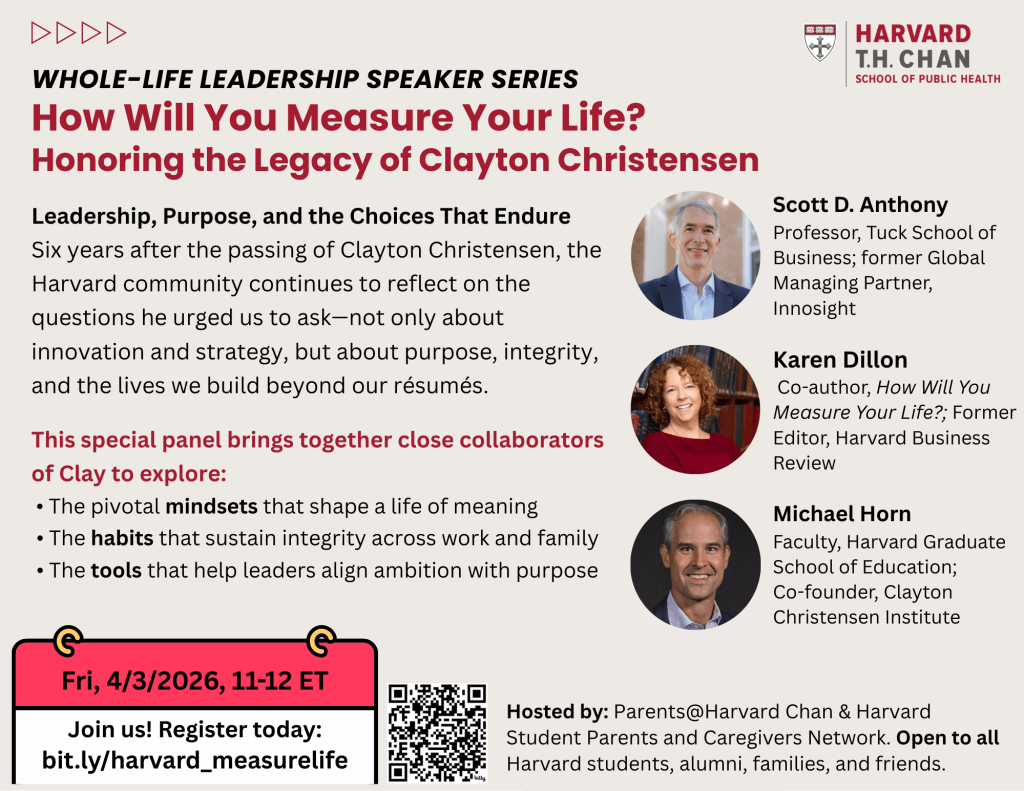
Our next Whole-Life Leadership conversation will continue this exploration from another angle.
If Erica Chen challenged us to ask, Whose story am I living—and why do I feel guilty when I try to live differently? our next event asks a closely related question:
What am I actually building my life around?
On Friday, April 3, we’ll host a special panel honoring the legacy of Clayton Christensen, six years after his passing.
Best known for reshaping how the world thinks about disruptive innovation, Clay also pushed people to wrestle with deeper questions of purpose, integrity, trade-offs, and how to live a life that matters beyond a résumé.
This conversation will feature three close collaborators and interpreters of Clay’s work:
- Karen Dillon — Co-author of How Will You Measure Your Life?; former Editor, Harvard Business Review
- Scott D. Anthony — Professor, Tuck School of Business at Dartmouth; former Global Managing Partner, Innosight; HBS alum
- Michael Horn — Co-founder, Clayton Christensen Institute; faculty, Harvard Graduate School of Education; HBS alum
Together, they will explore:
- How Clay’s thinking on purpose, trade-offs, and integrity applies across work, family, and life
- Why designing systems and habits, rather than relying on willpower, is essential for living in alignment with our values
- How leaders navigate seasons of ambition, constraint, parenthood, and responsibility without losing what matters most
- Why Clay’s ideas continue to resonate so deeply with people reflecting on legacy, meaning, and long-term impact
If Erica helped us reflect on identity and inherited narratives, this next conversation invites us to think more deliberately about measurement, alignment, and the architecture of a well-lived life.
💡 Whole-Life Leadership: How Will You Measure Your Life? Honoring the Legacy of Clayton Christensen
🗓 Friday, 4/3/2026
🕛 11am–12pm ET
💻 Virtual (Zoom)
👥 Open to all Harvard students, alumni, families, and friends
Register here: https://bit.ly/harvard_measurelife

 WeZBest